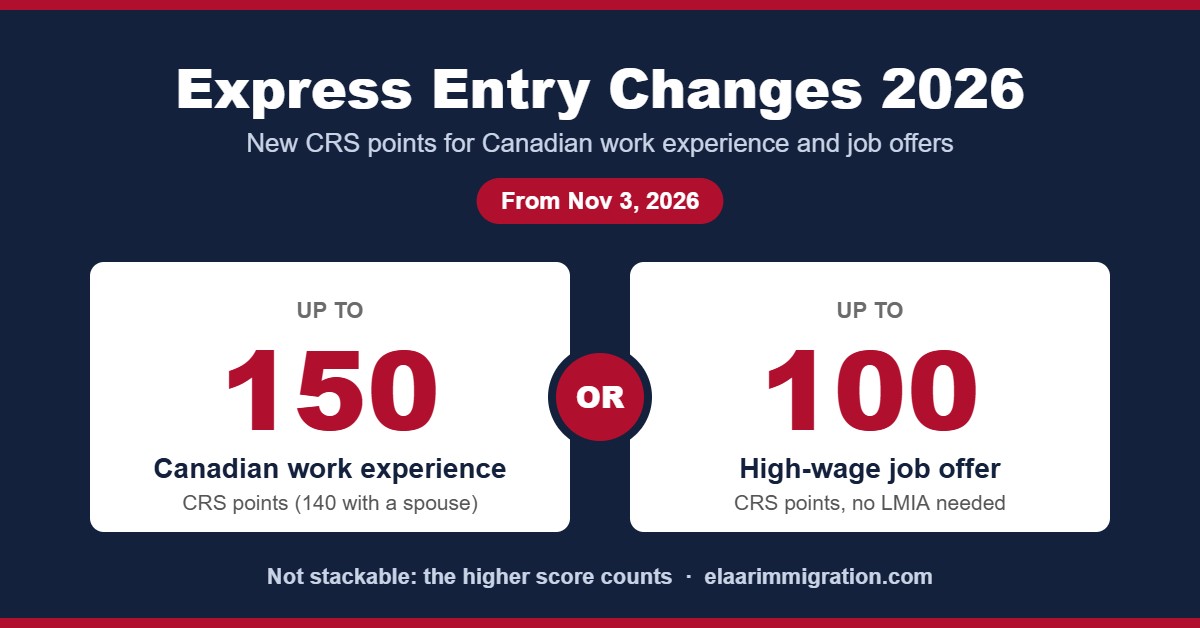
IRCC has announced changes to Express Entry’s Comprehensive Ranking System (CRS), effective November 3, 2026. Eligible Canadian work experience can earn up to 150 points, while qualifying offers in designated high-wage occupations can earn up to 100 points. Candidates who qualify under both options receive whichever score is higher, not both. The new rules also remove the LMIA requirement for qualifying Express Entry job offers. The impact will depend on the candidate’s occupation, eligible Canadian experience and the terms of any job offer.
 Written & reviewed by Keshav Sharma, RCIC #R530203, Founder, ELAAR Immigration Consulting Inc.Last reviewed: October 202615 min read
- Effective date: November 3, 2026
- Canadian work experience: up to 150 points (140 with an accompanying spouse or common-law partner)
- High-wage job offer: 100, 70 or 50 points, depending on the occupation’s wage tier
- Not combined: IRCC uses the higher of the two scores
- LMIA: no longer needed for a qualifying Express Entry job offer
IRCC advises candidates who may qualify for job-offer points to review their profiles before November 3, 2026 and make sure all qualifying job-offer information is included and accurate. A separate temporary method for entering offers without an LMIA applies from November 3 while the online system is being updated.
Sources: IRCC, 2026 changes to points for Canadian work experience and job offers and news release, October 16, 2026.
What is changing in Express Entry on November 3, 2026?
IRCC is adding a Labour Market Integration factor to the CRS. It scores either your Canadian work experience or a qualifying job offer in a high-wage occupation, up to 150 points. Job offers in high-wage occupations earn CRS points again, and an LMIA is no longer needed for them.
Job offer points were removed from the CRS on March 25, 2025. From November 3, 2026, they return, but only for occupations on IRCC’s high-wage list. Qualifying experience in designated high-wage occupations can earn an additional 20, 40 or 70 points.
IRCC will recalculate existing profiles when the changes take effect. The changes page states this “could take up to two weeks” and that invitation rounds will pause until it is complete.
What is a high-wage occupation?
IRCC defines a high-wage occupation as one whose median wage is at least 1.3 times the average median wage of the overall Canadian workforce. The test applies to everyone in Canada working under that National Occupational Classification (NOC) code, not to your own salary.
The high-wage occupation list in effect on November 3 has 186 NOCs: 31 at 2x the average median wage, 89 at 1.5x and 66 at 1.3x. IRCC sets each tier using three years of Job Bank, Labour Force Survey and Census data, currently 2023 to 2025. IRCC assigns an occupation the highest high-wage tier that its median wage met in any one of the three years, rather than averaging the three yearly tiers.
How do Canadian work experience points work after the Express Entry changes?
Canadian work experience points now have two components. Work-length points stay the same as today. High-wage points of 20, 40 or 70 are added if at least 12 months of that experience was in eligible high-wage occupations.
Work-length points (unchanged)
| Canadian work experience | With accompanying spouse/partner (max 70) | Without accompanying spouse/partner (max 80) |
|---|---|---|
| Less than 1 year | 0 | 0 |
| 1 year | 35 | 40 |
| 2 years | 46 | 53 |
| 3 years | 56 | 64 |
| 4 years | 63 | 72 |
| 5 years or more | 70 | 80 |
Additional high-wage points (new)
| Qualifying high-wage experience | Points |
|---|---|
| 12+ months in occupations at least 2x the average median wage | 70 |
| 12+ months combined at least 1.5x (if not eligible for 70) | 40 |
| 12+ months combined at least 1.3x (if not eligible for 40) | 20 |
| Less than 12 months in high-wage occupations | 0 |
The 12 months means at least 1,560 hours. It can be continuous or broken up, full-time or the equivalent in part-time, and combined across jobs. Hours from jobs held at the same time count only up to 30 hours per week.
Not every period of employment in Canada qualifies for CRS Canadian work-experience points. The new high-wage points use qualifying Canadian work experience under the applicable Express Entry CRS rules, and IRCC says those existing requirements are not changing. Candidates should check the applicable time period, authorization to work, nature of the employment and any exclusions before counting their hours.
The Canadian Experience Class also has its own minimum eligibility rules, including restrictions affecting certain work performed during full-time study and self-employment. Those program-entry rules should not be treated as a substitute for checking the CRS definition of qualifying Canadian work experience. Where the work history includes study periods, self-employment or unusual work arrangements, the correct treatment should be reviewed against the applicable rules.
How do job offer points work under the new Express Entry rules?
From November 3, 2026, a qualifying job offer in a high-wage occupation earns 100, 70 or 50 CRS points. An offer in an occupation that is not on IRCC’s high-wage list earns 0 CRS points, even if it is otherwise valid.
| Job offer occupation | CRS points |
|---|---|
| High-wage, at least 2x the average median wage | 100 |
| High-wage, at least 1.5x but under 2x | 70 |
| High-wage, at least 1.3x but under 1.5x | 50 |
| Not a high-wage occupation | 0 |
What makes a job offer qualify?
The correct NOC is only one part of a qualifying offer. According to IRCC’s job offer requirements, an offer generally must be:
- paid, full-time (at least 30 hours a week), continuous and not seasonal
- for at least one year after you become a permanent resident
- genuine, as assessed by an IRCC officer
- for a job you are qualified to perform
IRCC requires a job offer to be recent and in writing, and to state the pay and deductions, duties and conditions of employment, including hours of work. It must not come from an embassy, high commission or consulate in Canada. The offer must also meet the requirements of the Express Entry program under which the applicant qualifies. A work permit, including a PGWP or another open work permit, is not itself a job offer.
Some groups have their own rules. Federal Skilled Trades offers can come from up to two employers, and a temporary public policy gives certain physicians different requirements. Your situation should be checked against IRCC’s detailed requirements rather than this summary.
What if my job offer changes or is withdrawn?
If an employer withdraws a job offer or its terms change, do not assume the same points can still be claimed. Eligibility and CRS points may need to be reassessed, particularly after an invitation has been issued. IRCC’s news release states that a revoked offer no longer qualifies.
Do job offers still need an LMIA?
No. From November 3, 2026, an LMIA is not required for a qualifying job offer to count for Express Entry. IRCC also states that having an LMIA gives no extra CRS points or priority.
The removal of the LMIA requirement applies to qualifying job offers assessed under Express Entry. It does not eliminate LMIA requirements under the Temporary Foreign Worker Program or the separate rules governing employer-specific work permits. Employers must still follow the requirements applicable to hiring a foreign worker.
IRCC’s October 16, 2026 backgrounder announces a temporary public policy exempting candidates invited to apply on or after November 3, 2026 from LMIA and LMIA-exemption-related requirements for qualifying FSWP and FSTP job offers, provided the conditions of that policy are met. This is announced relief for the specified invitation dates, not a statement that every offer automatically qualifies. The program-specific job-offer requirements and genuineness assessment continue to apply.
Can I receive points for both?
No. IRCC calculates your Canadian work experience score and your job offer score under the Labour Market Integration factor and counts only the higher one.
Up to 150 points without an accompanying spouse or common-law partner, or up to 140 points with an accompanying spouse or common-law partner. The distinction is whether the spouse or partner accompanies the principal applicant, not simply whether the applicant is married.
Worked examples: how the new points add up
These examples illustrate only the Labour Market Integration factor, not a complete CRS score or an individual eligibility assessment. Each calculation assumes the work experience or job offer meets the applicable requirements and that the stated NOC and wage tier are correct.
Candidate A: single, 3 years as a software engineer in Canada
NOC 21231, 1.5x tier. No job offer.
| Component | Points |
|---|---|
| Canadian work experience: 3 years | 64 |
| Additional high-wage experience (1.5x tier) | 40 |
| Labour Market Integration score | 104 |
Under the current rules, the same experience earns 64. The high-wage component adds 40.
Candidate B: 4 years as a civil engineer in Canada, with an accompanying spouse
NOC 21300, 1.5x tier. No job offer.
| Component | Points |
|---|---|
| Canadian work experience: 4 years (with accompanying spouse) | 63 |
| Additional high-wage experience (1.5x tier) | 40 |
| Labour Market Integration score | 103 |
An accompanying spouse or partner lowers the work-length points, not the high-wage points. Candidates with or without an accompanying spouse can receive up to 70 high-wage points.
Candidate C: single, living abroad, job offer as a financial manager
NOC 10010, 2x tier. No Canadian work experience.
| Component | Points |
|---|---|
| Canadian work experience | 0 |
| Qualifying job offer (2x tier) | 100 |
| Labour Market Integration score | 100 |
For a candidate with no Canadian experience, a high-wage offer is the only way to earn points under this factor. Today, the same offer earns 0 CRS points.
Candidate D: single, 2 years in Canada in a non-high-wage occupation, job offer as a web developer
Job offer in NOC 21234, 1.3x tier.
| Component | Points |
|---|---|
| Work experience route: 2 years, no high-wage experience | 53 |
| Job offer route (1.3x tier) | 50 |
| Labour Market Integration score (higher route) | 53 |
The 50-point offer does not change this score because the experience route is already higher. A candidate in this position may gain nothing from a 1.3x offer.
Candidate E: single, 8 months as a software engineer, then 6 months as a web developer
NOC 21231 (1.5x) for 8 months, then NOC 21234 (1.3x) for 6 months. No job offer.
| Component | Points |
|---|---|
| Canadian work experience: 1 year | 40 |
| Additional qualifying high-wage experience (1.3x tier) | 20 |
| Total Labour Market Integration score | 60 |
Candidate E has 14 months of qualifying Canadian experience in occupations at or above the 1.3x wage tier, but only eight months at or above the 1.5x tier. On the stated facts, the work-length component is 40 points and the additional high-wage component is 20 points. The Labour Market Integration score is therefore 60; the 12-month threshold for the 40-point high-wage tier has not been reached.
Candidate F: 1 year as a corporate sales manager in Canada, with an accompanying spouse and a job offer in the same role
NOC 60010, 2x tier.
| Component | Points |
|---|---|
| Work experience route: 1 year (35) + high-wage experience, 2x tier (70) | 105 |
| Job offer route (2x tier) | 100 |
| Labour Market Integration score (higher route) | 105 |
Even a top-tier offer adds nothing here, because one year of 2x experience already scores higher. This example also shows the new factor is not limited to engineering and technology roles.
The 100-point job-offer route in this example assumes that the corporate sales manager offer is genuine and meets all applicable Express Entry job-offer requirements. The example is intended to show why the two routes must be calculated separately, not to establish eligibility from a job title alone.
Who is most likely to gain points?
Candidates with at least 12 months of qualifying Canadian work experience in high-wage occupations may receive extra points based on their occupation’s tier. Candidates outside Canada with a genuine qualifying high-wage job offer may also benefit, even without Canadian work experience.
The result will be different for candidates whose Canadian experience is outside the high-wage list. A qualifying offer may not increase their Labour Market Integration score if the points already earned for their Canadian experience are higher. Each candidate should calculate both routes rather than assuming a new offer will automatically improve the score.
Does this change Federal Skilled Worker or Federal Skilled Trades eligibility?
Yes. The announced changes affect how a job offer can support eligibility under these two programs, separately from CRS points.
Federal Skilled Worker Program (FSWP). Arranged employment remains worth up to 10 points toward the minimum 67 selection points. Under IRCC’s announced November 3 changes, a qualifying job offer may allow an applicant to claim these selection points without an LMIA, subject to the temporary public policy and its conditions. The offer must still meet FSWP requirements, including the applicable occupational and employment conditions. These 10 FSWP selection points are different from CRS job-offer points.
For example, an applicant with 60 FSWP selection points could potentially reach 70 with the 10 arranged-employment points from a qualifying offer. If that offer is in an eligible occupation that is not on IRCC’s high-wage list, it may help with FSWP eligibility while adding zero CRS job-offer points.
Federal Skilled Trades Program (FSTP). Applicants must still meet the designated skilled-trade requirements and have either a qualifying job offer for at least one year or a certificate of qualification from the appropriate Canadian authority. Under the announced November 3 temporary public policy, qualifying job offers may satisfy the FSTP job-offer route without an LMIA, subject to the policy’s conditions. An unrelated TEER 0–3 job offer does not automatically establish FSTP eligibility.
In both programs, a job offer can assist with program eligibility without earning CRS job-offer points. The two tests must be assessed separately.
See our Federal Skilled Worker Program requirements and Federal Skilled Trades Program pages.
Officer’s Lens: How IRCC may review job offers later
Without an LMIA, IRCC still assesses whether a job offer is genuine, and that assessment may take place when the permanent residence application is reviewed rather than when points are claimed.
IRCC states that officers will look at whether the employer is actively engaged in its business, can fulfil the terms of the offer, and complies with employment and recruitment laws. They will also look at whether you are qualified for the job and likely to accept and perform it.
To confirm these points, an officer may examine evidence such as:
- business records showing the employer is operating
- the employer’s ability to pay the offered wage
- the applicant’s qualifications, licensing and experience
- whether the job duties match the NOC claimed
These are examples of what may be reviewed, not a mandatory document checklist.
Your actual salary does not determine your high-wage points. IRCC classifies occupations using national wage data, not what an individual applicant earns or is offered. For example, a software engineer or HR manager earning $20 per hour does not automatically lose high-wage points because of that salary. The occupation’s NOC category determines the points, provided the work experience or job offer meets the applicable requirements.
However, a salary significantly below what is normally expected for the position may raise questions about the duties and the genuineness of the employment or offer. The occupation may qualify for high-wage points, but that does not mean the employment itself is automatically accepted.
Your previous Canadian experience can be more valuable than your current occupation. An applicant who previously worked in a 2× occupation and now works in a 1.3× occupation can still qualify for 70 additional points if they accumulated at least 12 months of qualifying Canadian experience in the higher-tier occupation. That experience doesn’t have to be from your current job, and you don’t need a job offer for the previous position.
Changing your NOC to gain CRS points could backfire. The NOC must reflect the duties actually performed, not simply the job title. You can support a genuine promotion or correction of an incorrectly selected NOC with employment records. However, changing the description of previous employment merely to qualify for a higher-point occupation may raise misrepresentation concerns.
Higher CRS points do not necessarily mean better chances of receiving an ITA. A candidate whose CRS score increases from 470 to 540 may appear much stronger. However, if many other candidates also receive additional points, their relative ranking may not improve by the same margin. The actual impact will depend on the score distribution in the pool and future invitation rounds.
How do I update my Express Entry profile for the changes?
There are two separate steps here, and the timing matters.
Before November 3, 2026: review your profile. Check:
- Your NOC code against your actual duties, not only your job title.
- Your occupation’s tier on IRCC’s high-wage list.
- Your qualifying hours, including the 1,560-hour minimum and the 30-hour weekly cap for jobs held at the same time.
- Your job offer against IRCC’s requirements, including the NOC on the offer letter.
From November 3, 2026: use IRCC’s transitional entries for a genuine qualifying offer. IRCC’s changes page states that its online system has not yet been updated. Until it is, the profile still asks whether you have a positive LMIA. IRCC instructs candidates to enter the following in the work history section:
| Profile field | Value IRCC instructs you to enter |
|---|---|
| Was a positive LMIA issued for the job offer in Canada? | Yes |
| LMIA Number | 00000 |
| LMIA Issuance Date | 2026-01-01 |
| LMIA Expiry Date | 2029-01-01 |
These placeholder values are IRCC’s own transitional instruction. Use them only for a genuine job offer that meets the requirements. Keep a dated copy of IRCC’s instruction page with your records.
What happens to the high-wage list after I get an invitation?
IRCC keeps using the tier that applied on the date of your invitation to apply (ITA). If your occupation later moves tiers, is removed or is added, your assessment stays tied to your ITA date.
The list will be revised as new data comes in, and IRCC has not published a fixed schedule. If you are relying on a specific tier, check the list again before you claim points.
How do the Express Entry changes compare with the current rules?
| Factor | Before Nov 3, 2026 | From Nov 3, 2026 |
|---|---|---|
| Canadian work experience (without accompanying spouse) | Up to 80 | Up to 150 |
| Canadian work experience (with accompanying spouse) | Up to 70 | Up to 140 |
| Job offer CRS points | 0 (since March 25, 2025) | 100 / 70 / 50, high-wage only |
| LMIA for an Express Entry job offer | Generally required, with certain LMIA exemptions | Not required |
| Skills transferability | Existing rules | Unchanged |
Skills transferability points do not use the high-wage rules. Core factors such as age, education and language are not part of this announcement.
Curious how these changes impact your CRS score? Use our updated CRS calculator to see if you qualify under the new 2026 Express Entry rules!
Frequently asked questions
Can I get points for both a job offer and Canadian experience?
No. IRCC compares the two scores and awards the higher one. They cannot be combined.
Is my salary used to decide if my job is high-wage?
No. IRCC uses the median wage of everyone in your NOC across Canada. A well-paid job in an occupation that is not on the list does not earn high-wage points.
If I receive a promotion to a high-wage occupation, can I claim high-wage experience points immediately?
Not necessarily. A genuine qualifying offer for the new position may be assessed under the job-offer route. High-wage Canadian work-experience points, however, depend on the qualifying experience actually accumulated in eligible occupations. A new title or promotion does not retrospectively change the duties and NOC classification of past work.
Does part-time work count toward high-wage points?
Yes, if it adds up to 1,560 hours in eligible high-wage occupations. Hours from jobs held at the same time count only up to 30 hours a week.
What if I was invited before November 3, 2026?
IRCC’s announced LMIA relief for Federal Skilled Worker and Federal Skilled Trades eligibility applies to candidates invited on or after November 3. Check IRCC’s official transitional guidance for earlier invitations rather than assuming the new rules apply.
Does a job offer affect proof of funds?
It can. Under IRCC’s proof of funds rules, you do not need to show settlement funds if you are authorized to work in Canada and have a valid job offer. Without both, the funds requirement may still apply.
How do these changes interact with a provincial nomination?
They are separate. A provincial nomination adds 600 CRS points under federal rules, while each province sets its own job offer and stream criteria. An offer accepted by a province does not automatically earn federal job offer points.
What should you do next?
Check your NOC on IRCC’s high-wage list and work out which route, Canadian experience or a job offer, gives you the higher score.
If you are unsure whether your Canadian work experience or job offer qualifies under the new rules, ELAAR can review the NOC classification, program eligibility and supporting documents before you update your profile.
About the author: Keshav Sharma is a Regulated Canadian Immigration Consultant (RCIC #R530203) and the founder of ELAAR Immigration Consulting Inc. View author profile
Reviewed by: Keshav Sharma, RCIC #R530203
Last reviewed: October 2026
This article is based on official IRCC sources and was last reviewed in October 2026. Immigration rules can change without notice, so always verify current requirements on canada.ca before making any application decisions.
This content is for general information only and does not constitute legal or immigration advice. For advice specific to your situation, consult a licensed Canadian immigration professional, such as a Regulated Canadian Immigration Consultant (RCIC) or immigration lawyer.